
Building Custom AI Agents with Google ADK and Integration Connectors
- Hassan Nishat
- Sep 19, 2025
- 3 min read

Updated: Sep 23, 2025
Artificial intelligence is no longer just a research project, it’s becoming a practical tool for businesses of every size. One of the most powerful ways to unlock this value is through custom AI agents: intelligent systems that automate workflows, integrate data, and provide real-time insights.
At Daily Solutions, we design and deploy these agents using the Google Agent Development Kit (ADK) alongside Google Cloud Integration Connectors. Together, they provide a flexible foundation to build enterprise-grade AI solutions tailored to each client’s unique needs.
Why Custom AI Agents Matter
Most businesses today rely on multiple disconnected systems: CRMs, ERPs, spreadsheets, analytics platforms, and messaging tools. Employees waste countless hours moving data between them, generating reports, and checking compliance rules.
Custom AI agents bridge these gaps by:
Automating repetitive processes
Unifying data from different platforms
Providing natural-language answers to business questions
Enforcing company-specific rules and logic
The result is less manual work, faster insights, and more time for teams to focus on strategic goals.
The Role of the Google Agent Development Kit (ADK)
The Google Agent Development Kit (ADK) provides a robust framework for building agents that are not only powered by large language models, but also designed for enterprise workflows.
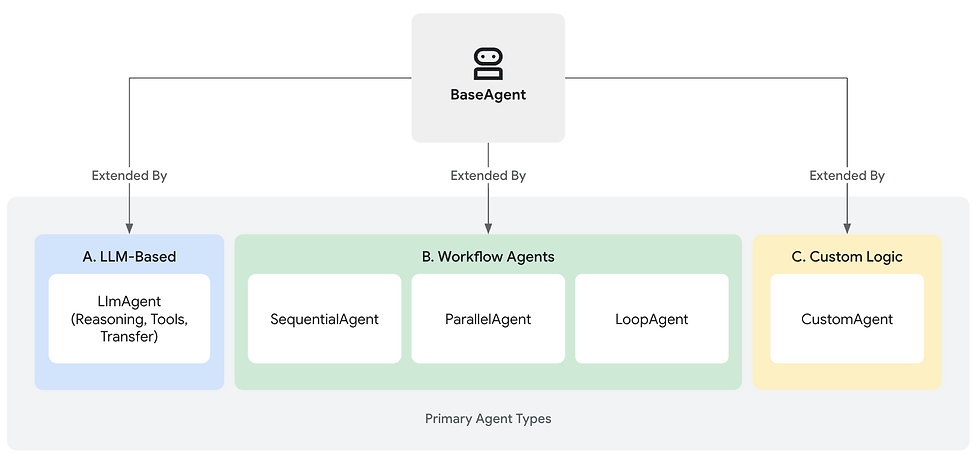
Key agent types include:
LLM-Based Agents – Reason, analyze, and answer questions in natural language.
Workflow Agents – Execute structured, multi-step processes reliably.
Custom Logic Agents – Apply business-specific rules, policies, and decision-making.
By combining these types, we can design agents that think, act, and adapt — whether that’s generating a forecast, processing purchase orders, or monitoring customer support tickets.
Connecting the Dots with Google Cloud Integration Connectors
While the ADK powers the “intelligence” of the agent, the Integration Connectors handle the connectivity. These prebuilt connectors link the agent to 100+ enterprise platforms, databases, and SaaS tools.
For example, connectors make it possible for an agent to:
Pull leads from Salesforce
Enrich customer data from HubSpot
Analyze sales numbers from BigQuery
Post daily updates directly into Slack
Without connectors, businesses would need expensive custom API integrations. With them, we can build scalable solutions much faster and at lower cost.
A General Implementation Approach
When building custom agents for clients, our process follows four main steps:
Discovery – Identify high-value workflows that would benefit most from automation (reporting, forecasting, approvals, onboarding, etc.)
Design – Choose the right mix of agent types (LLM-based, workflow, custom logic) and map the required integrations.
Build – Use Google ADK to develop the agent, and connect it to existing business systems via Integration Connectors.
Deploy & Monitor – Launch the agent in the client’s Google Cloud environment, with continuous monitoring and optimization for accuracy and efficiency.
This approach ensures each solution is tailored to the client’s real business needs rather than forcing a one-size-fits-all model.
Example: Sales Pipeline Agent
Imagine a sales manager who spends every morning compiling updates from different systems.
With a custom agent, we can:
Workflow Agent: Pull new leads from Salesforce and HubSpot
LLM-Based Agent: Analyze and rank the leads based on potential
Workflow Agent: Post a summary to Slack and update a Google Sheet dashboard
The manager starts the day with a complete, automated pipeline view — no spreadsheets, no manual updates.
Looking Ahead
AI agents are not a distant future technology — they are practical, available, and ready to bring measurable value to businesses today.
By combining the Google Agent Development Kit with Google Cloud Integration Connectors, we can help organizations streamline operations, eliminate repetitive tasks, and unlock new levels of efficiency.
At Daily Solutions, our mission is to make this technology accessible for small and mid-sized businesses, professional service firms, and tech-forward companies who want to stay ahead in a competitive market.


Comments